


Whether Amanda Ruiz is designing proteins on a computer, screening them in yeast, or studying immune responses in mice, she keeps one clear image in mind.
“At the end of the day, there are humans behind what I’m studying,” she says. To her, the lab bench is merely a vehicle on a journey toward populations in need.
From parasitic worms to viruses and from water buffalo to yeast, that humanistic perspective has carried Ruiz from her early years at the Bronx High School of Science to the Institute for Protein Innovation (IPI), where tools in antibody discovery and computational design are helping her to build immune protection for people, protein by protein.
In June 2026, she received the inaugural IPI Springer-Lu Postdoctoral Fellowship, a joint fellowship, in her case, between IPI and the Ragon Institute of Mass General Brigham, MIT and Harvard. Ruiz now draws on IPI’s expertise to discover and develop a vaccine against a widespread family of viruses, designed to elicit precise and durable protection.
Everyday exposure
Born and raised in Queens and the daughter of immigrants, Ruiz is — by her own account — “very much a New Yorker.” She grew up loving the city’s busy 24/7 energy, the diversity, the “stories of triumph” born from its streets.
Outside of school, she was drawn to the courts, playing competitive basketball from the age of eight. But in school, she gravitated toward immunology and microbiology, an interest that was deeply personal.
On childhood visits to Colombia’s Caribbean coast, where her mother grew up, Ruiz noticed hazards that rarely touched her life in New York. Her relatives boiled water before drinking it. Heavy rain could overwhelm the sea-level drainage system, leaving standing pools of contaminated water. After sundown came mosquitoes, and with them the risk of dengue and other illnesses.
“There are these constant public health insults that occur throughout someone’s day,” she says.
No single risk was egregious, but the insults accumulated over time to present life-altering health challenges unlike anything she knew in Queens. Ruiz was acutely aware that her parents — and an element of luck — had placed her on one side of that divide.
As she progressed in her studies, she began to see a way to merge that human understanding with the science she’d been drawn to since high school, which naturally evolved into a focus on vaccinology, immunology, and protective immune response.
Worms to water buffalo
In 2018, after earning her bachelor’s in cellular and molecular biology from Barnard College of Columbia University and spending one year as a research technician at Columbia University Irving Medical Center, she entered Brown University’s pathobiology Ph.D. program in the lab of Jonathan Kurtis. There, she began investigating immune responses to the intestine- and liver-affecting Schistosoma japonicum infection, caused by a parasitic worm, or helminth, endemic to East and Southeast Asia.
Schistosomiasis, which infects both humans and animals, spreads easily in fresh water where the parasite is released by infected freshwater snails. In some areas, water buffalo — grazing in water and plowing flooded rice paddies — help keep the parasite circulating among rural populations. Each year, according to the World Health Organization, the infection kills an estimated 14,000 people, and more than 250 million require preventive treatment.
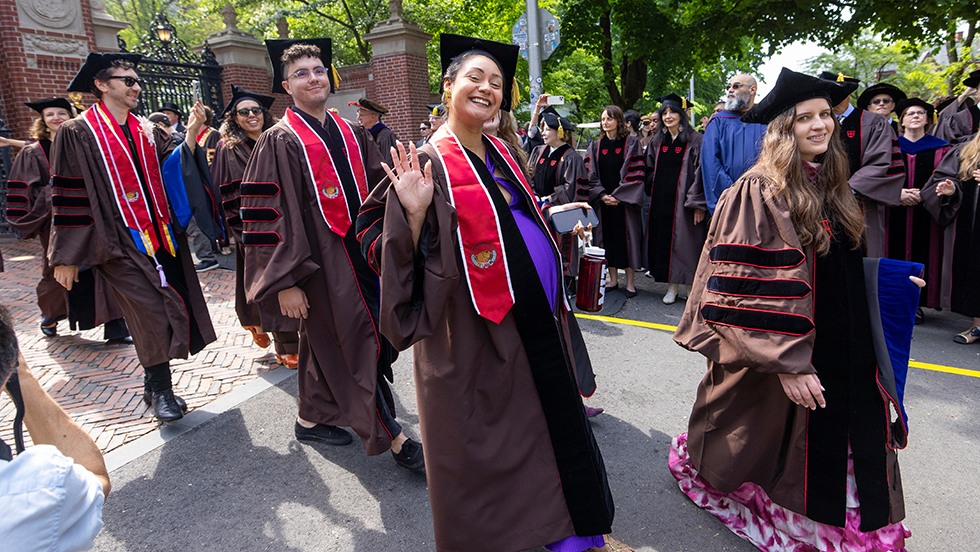
Seeking a way to interrupt this cycle, Ruiz worked at Brown to identify parasite antigens that could form the basis of a vaccine for both people and livestock, publishing her progress in The Journal of Infectious Diseases.
At the same time, her advisor felt strongly that disease studies should be addressed alongside the communities most affected. Thus, toward the end of her doctorate, Ruiz traveled to Barangay Manggas, an agricultural village in the Philippines, to observe the final stages of an mRNA vaccine trial in water buffalo led by immunologist Mario Antonio Jiz II at the Research Institute for Tropical Medicine. She donned giant galoshes and protective gear to visit an inland farm, participating in water buffalo necropsies, assessing vaccine effectiveness, and witnessing schistosomiasis’s impact on the village firsthand.
Those experiences and the desire to do more prompted her to join the American Society for Tropical Medicine and Hygiene, working with researchers from the Global South and learning how policy and implementation strategies — beyond medical research and vaccinology — affect health outcomes.
“Even if my goal is to do global health research from a bench,” she says, “I should have a firm understanding of what it’s like to be in those communities, to learn from people who contract those diseases and live with that as a reality.”
Focusing the immune response
After six years working with helminths, Ruiz made a postdoctoral pivot to viruses. She joined the structural virology lab of Aaron Schmidt at the Ragon Institute and the B- and T-cell receptor profiling lab of Michael Birnbaum at MIT in 2024, focusing on designing novel vaccines for flaviviruses, a broad and impactful family of viruses including dengue, Zika, West Nile, and tick-borne encephalitis. Spread mainly by mosquitoes and ticks, flaviviruses reach much of the globe, infecting up to 400 million people per year.
Traditional vaccines introduce a partial fragment or benign form of an antigen into the immune system to trigger the body’s protective immune response. Typically, the antigen presented is a broad surface offering many binding sites, or epitopes. The immune system generates antibodies that target these exposed epitopes. Some antibodies will neutralize the virus, but others will offer no protective advantage — and can crowd out the ones that matter.
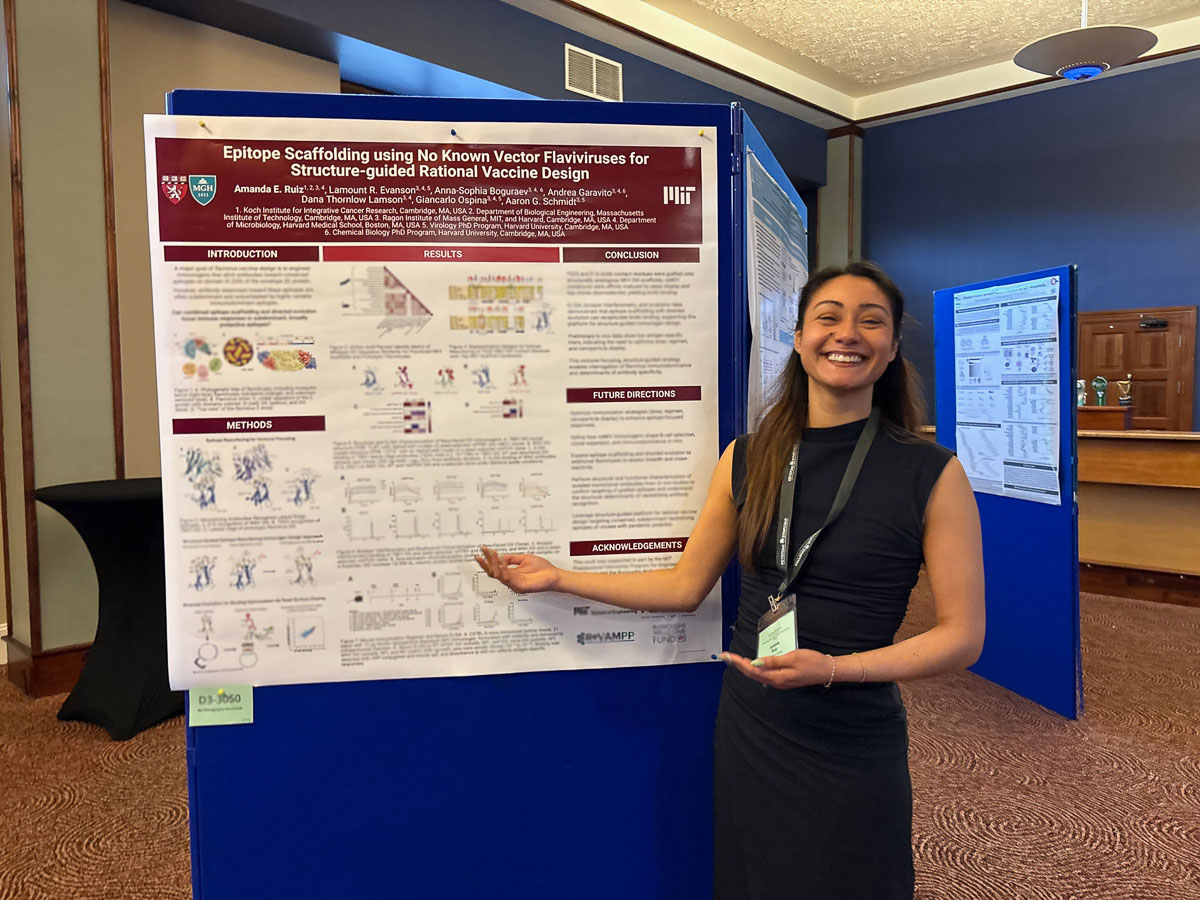
As a Springer-Lu Postdoctoral Fellow at IPI and the Ragon Institute, Ruiz is taking another approach, rational vaccine design, which aims to produce better vaccines by reverse-engineering the process. Using existing knowledge of protective antibodies — the ones that actually block infection and confer lasting immunity — researchers work backward to pinpoint the exact sites those antibodies lock onto, often conserved, partially occluded epitopes. Researchers then build an immunogen that displays only those protective sites while masking the regions that tend to attract neutralizing antibodies.
In theory, this trains the immune system to focus on the sites that confer protection, rather than the whole surface. The payoff, Ruiz hopes, is more persistent, longer-lasting vaccine protection.
“By controlling which epitopes the immune system sees,” she says, “I aim to design vaccines that are more effective across variants, more durable, and work against pathogens that have historically been difficult to vaccinate against.”
With IPI’s established antibody discovery platform, she is now taking that strategy to the next level. Alongside Senior Director of the Antibody Platform André Teixeira and computational biologist Yang Su, she has used computational tools, such as RFdiffusion and ProteinMPNN, to generate sequences for more than 4,000 scaffolds for each of three flaviviruses — West Nile, dengue, and tick-borne encephalitis.
She’s now screening those 12,000-plus scaffolds, scouting for immunogens whose bulk differs in amino acid makeup while the overall structure is preserved; critically, key protective epitopes must remain conformationally identical to the native protein. By redesigning the surrounding scaffold while maintaining the epitopes’ native conformation, she hopes to elicit antibodies that recognize and neutralize the virus without distracting the immune system with less useful targets.
The designs that show the most potential will then move to the bench, where she’ll use yeast display to determine which immunogens do in fact bind to neutralizing antibodies and E. coli display to evaluate protein folding and stability — together giving her an indication of which immunogens have a feasible future as vaccines.
“You could have the best immunogen, but if it degrades over time or starts to unfold, then it’s useless,” she says. “That’s really important from a vaccine standpoint.”
Building better outcomes and future labs
Taking on rational vaccine design for flaviviruses has been complex, elaborate, and years in the making. Ruiz is deeply committed, and the Springer-Lu Fellowship — established by the Springer-Lu Family Foundation to support early-career scientists pursuing high-risk, high-reward projects — is helping her achieve that lofty goal.
She’s garnered freedom and funding, along with a model for her own future lab: specialized teams, high-throughput systems, and mentors who build both projects and scientists — an example set by Teixeira, Su, and principal scientist Deepash Kothiwal, among many others, at IPI.
“The Springer-Lu Fellowship is pretty unique in that you’re learning side by side with scientists who are experts and leaders in the fields of protein design and antibody design,” she says. “It’s not just an investment in the project, but it’s an investment in you as a scientist.”

IPI is accepting applications for the Springer-Lu Postdoctoral Fellowship between November 2026 and January 2027. Find more information here.
Sources:
Amanda Ruiz, amanda.ruiz@proteininnovation.org
Writer:
Caitlin Faulds, caitlin.faulds@proteininnovation.org
About IPI
The Institute for Protein Innovation is pioneering a new approach to scientific discovery and collaboration. As a nonprofit research institute, we provide the biomedical research community with synthetic antibodies and deep protein expertise, empowering scientists to explore fundamental biological processes and pinpoint new targets for therapeutic development. Our mission is to advance protein science to accelerate research and improve human health. For more information, visit proteininnovation.org or follow us on social media, @ipiproteins.