


George Hong remembers the moment that redirected his career.
As a young scientist, he imagined he’d follow a formulaic path: finish graduate school, go through a postdoc, get grants, and establish a lab to spend the next decades pursuing a single important fundamental biological question.
Then, during his postdoc, Hong was attending an American Society for Microbiology conference in search of reagents for an HIV vaccine assay when a stranger stopped him with a simple question: “What are you looking for?”
The conversation soon turned to something deeper: “Why are you doing what you’re doing?” In that moment, Hong began to consider not only what he needed to develop the assay, but why he had chosen this life path. “It really resonated with me,” Hong recalls. “I’d never asked that.”
Would he be intrigued by a career answering one major scientific question after another—or could he find greater purpose bringing scientific breakthroughs to those who needed them most?
Over the next three decades, Hong hopped between the two paths, first working in the lab making discoveries and then shaping them into scientific or clinical tools.

Most recently, he joined the Institute for Protein Innovation (IPI) as its new director of commercialization. And a few months in, he is already translating scientific output into broader community impact.
Drawn to the basics
Long before big existential questions entered the picture, Hong was fascinated by the mind-blowing essentials of microbiology — like the fact that the human body contains trillions more bacterial cells than human cells.
“If we have more bacteria than human cells,” he remembers wondering, “what is really influencing our own biology?”
That curiosity led him to study microbiology and immunology, and eventually earn a Ph.D. at Duke University School of Medicine. There, he focused on the proteins that drive DNA replication and recombination, continuing into postdoctoral research to investigate mucosal immunity and explore vaccine strategies to strengthen the body’s first line of defense against viral infection.
The work was compelling but missing a final step.
“I wanted to touch more people,” he says. “I was more interested in the applications of the findings.”
Connecting science to people
Industry provided Hong with that opportunity. At Transgenomic, a molecular diagnostics company serving microbiology, cardiology, oncology, and inherited disease markets, he took on a strategic business development role. He established a new R&D lab focused on innovation and helped translate novel academic technologies for use in clinical, biopharma, biotech, and government laboratories.
A defining milestone in Hong’s career came when Advanced Instruments, a company known for its osmolality devices, entrusted him with leading North American sales and spearheading a groundbreaking project. There, he had the opportunity to collaborate with an inventor who shared his sense of purpose to develop a better imaging diagnostic test for patients with suspected meningitis.
The project gave Hong the opportunity to lead cross-functional teams spanning R&D and product development, including wet-lab scientists, electrical and software engineers, and colleagues in manufacturing, quality control, technical support, and customer support. Together, they identified a market need, guided the product through clinical trials, and developed a go-to-market strategy. Hong played a pivotal role in uniting these teams around a shared goal: launching a durable, reliable, and useful platform.
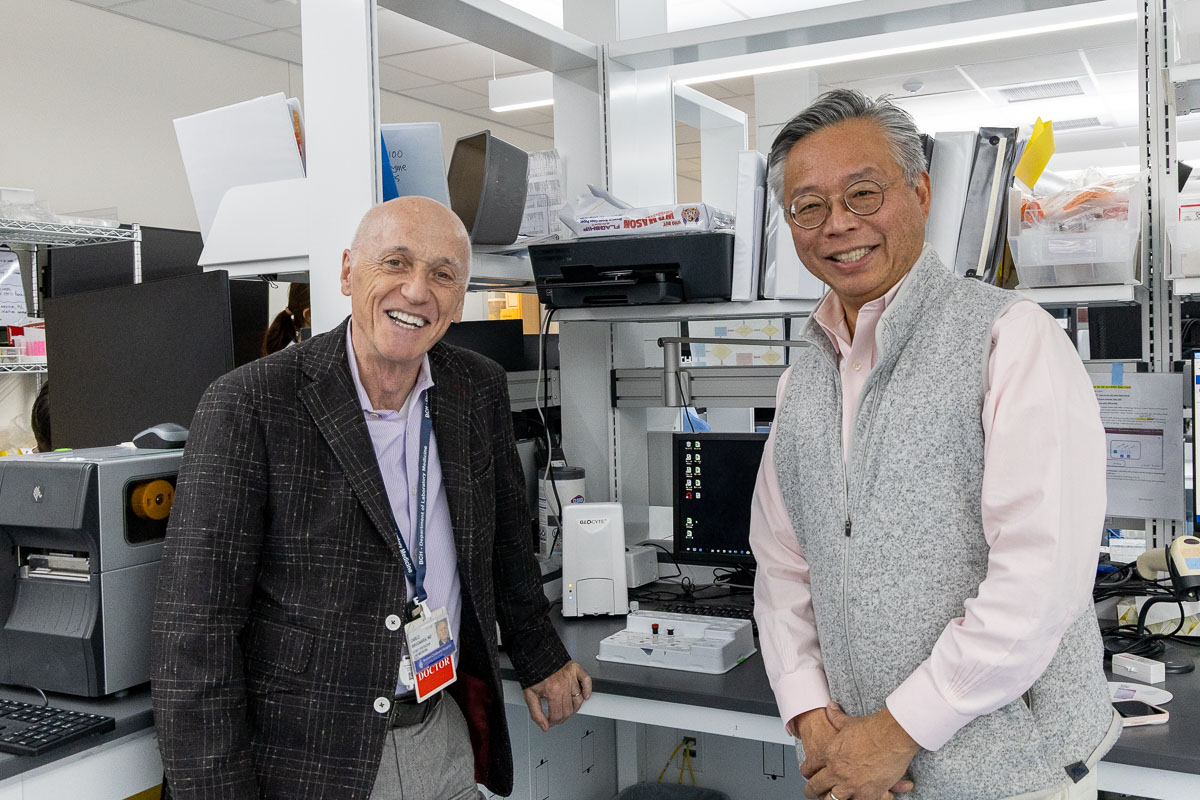
The resulting product analyzes cerebrospinal fluid from patients with suspected meningitis, replacing labor-intensive microscopic cell counts with faster, standardized analysis.
“The product has saved lives,” says Carlo Brugnara, director of the Hematology Laboratory at Boston Children’s Hospital and Professor of Pathology at Harvard Medical School.
Such feedback continues to motivate Hong to translate science into practice. And the successful product launch revealed something unexpected in the teams he led.
“Once people realized the difference they could make,” he says, “they surprised themselves.”
People-powered science
Moments like these convinced Hong of the intrinsic human side to science and business. He returned to school to earn his MBA from the Boston University Questrom School of Business. The experience taught him how to work with people, especially scientists with big ideas.
“Great ideas,” he says, “don’t really mean anything significant unless there’s somebody who can use them.”
He embraced these lessons, evolving into a leader also capable of understanding the nuance of scientific innovations, building a sustainable strategy around those ideas, and — importantly — shaping it all into a grand vision with tangible impact. That’s what allows discovery to make a lasting difference, he believes.
All the difference
That perspective made IPI an especially compelling destination.
Hong sees enormous capabilities and potential across the Institute — from its leadership in the neuroscience community and provision of reagent antibodies to its expertise in antibody discovery and protein engineering for diagnostic and therapeutic companies, as well as its thoughtfully designed educational workshops and courses that advance science.
His challenge is helping connect those capabilities to the researchers who need them while supporting the Institute’s long-term sustainability. That means understanding who IPI serves, listening carefully to researchers’ needs, and connecting scientists to the Institute’s growing portfolio of programming and offerings.
And, perhaps most importantly, bringing researchers and protein scientists together to focus on one sole mission: accelerating scientific protein discovery to improve human health.
“It’s difficult to start a fire with a single piece of wood,” Hong says pensively. “But when you pile the logs together, they create a roaring flame. Like those logs, we all long to belong — to come together, illuminate something greater than ourselves, and find a deeper sense of purpose.”
Sources:
George Hong, george.hong@proteininnovation.org
Writer:
Caitlin Faulds, caitlin.faulds@proteininnovation.org
About IPI
The Institute for Protein Innovation is pioneering a new approach to scientific discovery and collaboration. As a nonprofit research institute, we provide the biomedical research community with synthetic antibodies and deep protein expertise, empowering scientists to explore fundamental biological processes and pinpoint new targets for therapeutic development. Our mission is to advance protein science to accelerate research and improve human health. For more information, visit proteininnovation.org or follow us on social media, @ipiproteins.