

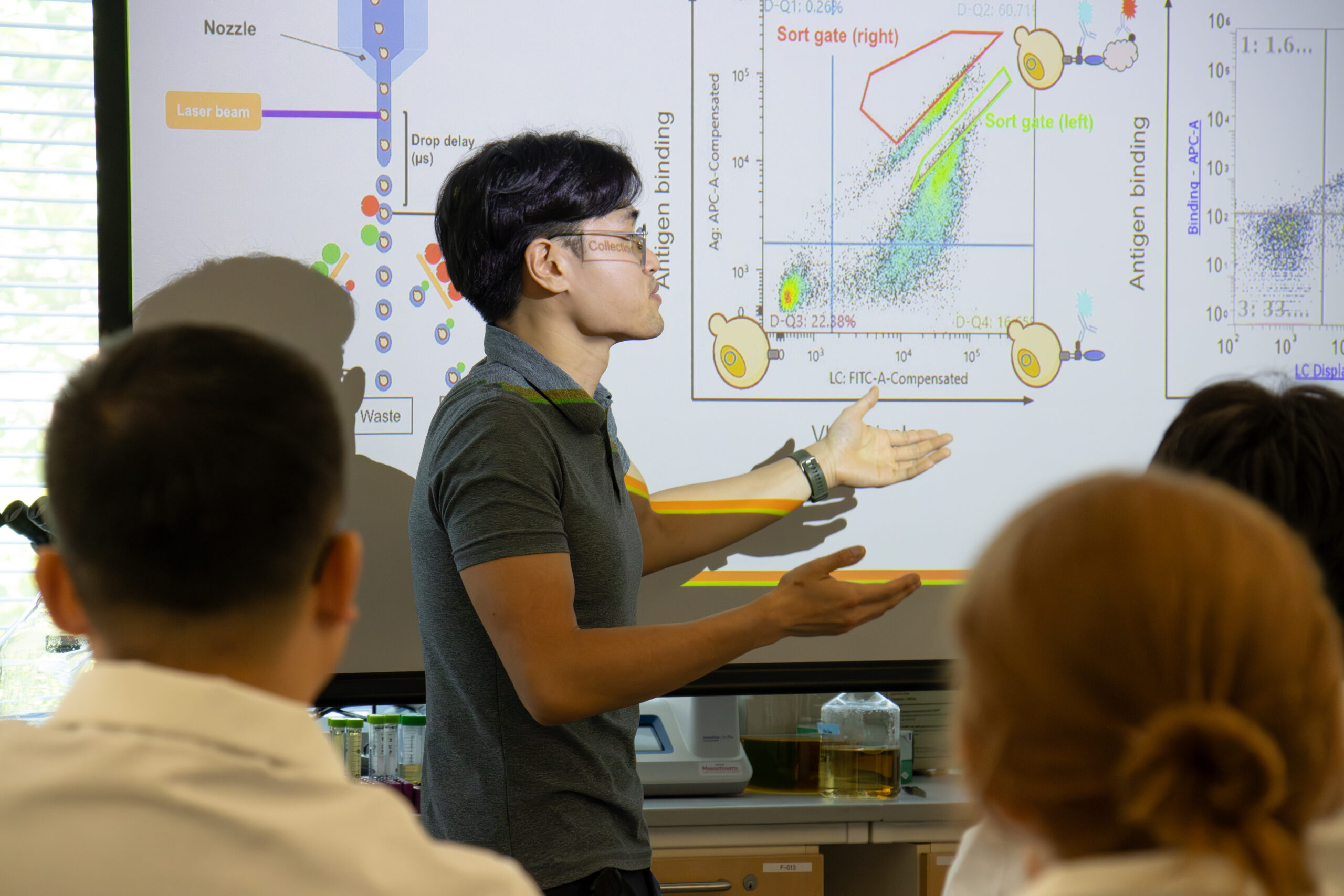
It’s his first time at the front of the Institute for Protein Innovation (IPI) classroom, but you wouldn’t know it.
Blue light reflecting off his glasses, Robert May confidently leads the group of lab-coated learners through the intricacies of antibody selection using yeast display. He explains the mechanics of flow cytometry, the nuances of gating cell populations, and the art of interpreting abstract plots of fluorescent scatter.
While a natural teacher, he himself was a learner two years ago, when he started as a research associate at IPI.
Since then, he’s become a core member of the IPI Antibody Discovery Team, helping to select high-affinity antibodies for hundreds of evasive targets and training younger research associates. Next month, he’ll be a full-time trainee again at the Graduate School of Biomedical Sciences at Tufts University. But now he has a grasp of yeast display technology and antibody discovery that few of his peers will ever acquire.
“Seeing how powerful the system that we’ve built here is — that’s really fascinating to me,” May says.
Spirit of science
While yeast display may be an acquired skill, May has always felt close to biology. He comes from a family of scientists — his mother a marine ecologist, his dad a neuroscientist, and his two older siblings happily situated in chemical engineering and psychology. Whether by nature or nurture, he leaned into the inquisitive, curiosity-steeped spirit of science.
As an undergraduate at Tufts University, he studied biology and was inspired by professor Benjamin Wolfe. He joined the Wolfe Lab as a Laidlaw Scholar and research assistant, using molecular biology techniques to study microbial ecology in model microbiomes of fermented foods. May concentrated on cheese rind yeast, mold, and bacteria — namely, Pseudomonas carnis — that co-occur in communities remarkably similar in composition to certain human microbiomes.
The work opened his eyes to RNA sequencing, gene expression characterization, experimental evolution, and the sheer number of compelling biological research questions. He finished his degree infatuated with biology — and looking to learn even more.
“I’m most excited about doing and exploring as many new things as I can,” May says.
Discovering something new
May took his seat at IPI’s Antibody Discovery bench in spring 2024. He was familiar with yeast, but completely new to antibody discovery. He loved the shift in focus.
In his early days, he learned how antibodies at IPI are displayed on the surface of yeast cells, and how this facilitates an iterative process of magnetic- and fluorescence-activated cell sorting (MACS and FACS). Then, he began to run this process, growing out antibody-bearing yeast cultures, incubating them with magnetic tags and fluorophore stains, and screening them using powerful benchtop flow cytometers. He figured out how to interpret the colorfully output flow cytometry plots, and gate for promising antibody candidates based on cell morphology, aggregation, and antibody binding.

Quickly, he mastered the basics and advanced to designing and building the yeast display libraries, themselves, to further optimize the search for quality research reagents. But more than that, May says the immersive research role sharpened his skills as a researcher and led him to view science in a whole new way — a shift in mindset he attributes to principal scientist and Antibody Discovery Team leader Deepash Kothiwal.
“He really encouraged us to engage in better and better levels of scientific thinking,” May says. “Not just running the protocols and keeping the pipeline going, but also having that element of questioning, being curious and always trying to improve.”
Just a few months after he joined, planning commenced for IPI’s inaugural yeast display course. He watched from the sidelines as the team built the course and decided, next time, he’d step in to join them.
After all, “the best way to know that you understand something is if you can teach it,” May says.
Back to school
Though he had plenty to learn over his two years at IPI, May says he “never stopped thinking about microbes.” He took this as a sign that maybe it was time to dive deeper and learn more about a particular biological niche.
In fall 2025, he began applying to graduate schools, with support from Kothiwal and others at IPI. And by spring 2026, as preparation for the Yeast Display course was in full swing, he earned a spot at the Tufts University Graduate School of Biomedical Sciences as an incoming Molecular Microbiology Ph.D. student.
Returning to Tufts, he’s eager to make the most of a department largely focused on infectious disease, bacterial pathogens, and host-pathogen interactions. Though he has his eye on a compelling fungal lab in particular, the degree will take him through rotations in multiple labs. May is keeping his options open, ready to learn and experience everything he can.
“Don’t be afraid to try lots of things,” May advises. “You never know what’s out there unless you put yourself in an unfamiliar place.”

Sources:
Robert May, LinkedIn
Writer:
Caitlin Faulds, caitlin.faulds@proteininnovation.org
About IPI
The Institute for Protein Innovation is pioneering a new approach to scientific discovery and collaboration. As a nonprofit research institute, we provide the biomedical research community with synthetic antibodies and deep protein expertise, empowering scientists to explore fundamental biological processes and pinpoint new targets for therapeutic development. Our mission is to advance protein science to accelerate research and improve human health. For more information, visit proteininnovation.org or follow us on social media, @ipiproteins.